
Are defects, winding issues, or inconsistent yield limiting your roll-to-roll (R2R) process? For many manufacturers, the next step is unclear. New inspection systems, improved web handling strategies, or process upgrades may offer a solution, but committing to a capital investment without validation introduces risk.
At Re:Build Optimation, we frequently work with teams facing this exact challenge. The question is not just how to improve performance, but how to do so with confidence. This blog explores how testing roll-to-roll improvements before investment can reduce risk, improve yield, and enable better decision-making through real-world data.
In roll-to-roll manufacturing, even small process variations can lead to significant defects. Wrinkles, winding inconsistencies, and coating variability often stem from complex interactions between materials, equipment, and operating conditions. When these issues arise, manufacturers typically explore solutions such as:
However, implementing these changes without validation introduces uncertainty. Will the new system perform as expected? Will it improve yield, or create new challenges? Without data, these decisions are often based on assumptions rather than evidence.
Evaluating roll-to-roll equipment upgrades in a real-world environment provides a critical advantage. Instead of relying on theoretical performance or vendor claims, manufacturers can observe how new technologies perform on their actual materials and processes. This approach reduces the risk associated with capital investment and enables more informed decision-making.
Testing before investing allows teams to:
By shifting from assumption-based decisions to data-driven evaluation, manufacturers can move forward with greater confidence.
Testing roll-to-roll systems and technologies in a controlled but realistic environment provides insight that is difficult to achieve through simulation or small-scale trials alone.
1. Validating Inspection and Measurement Systems
Many manufacturers consider new inspection technologies such as optical scanners to improve defect detection. However, performance can vary depending on material properties, defect types, and process conditions. Testing these systems on actual product material ensures that they deliver meaningful, actionable data.
2. Identifying Root Causes of Defects
Defects in roll-to-roll processing are often symptoms of deeper system-level issues. Without proper analysis, teams may address surface-level problems without resolving the underlying cause. Hands-on testing allows engineers to observe how variables such as tension, alignment, and speed interact, making it easier to pinpoint root causes and implement effective solutions.
3. Optimizing Web Handling and Winding Performance
Web handling plays a critical role in determining product quality. Small improvements in tension control, alignment, or roller configuration can have a significant impact on yield. Testing enables these variables to be adjusted and evaluated in real time, providing immediate feedback on performance improvements.
4. Making Data-Driven Investment Decisions
Perhaps the most important benefit of testing is the ability to make decisions based on real data rather than assumptions. By quantifying improvements in yield, defect reduction, and process stability, manufacturers can justify investments with confidence and avoid costly missteps.
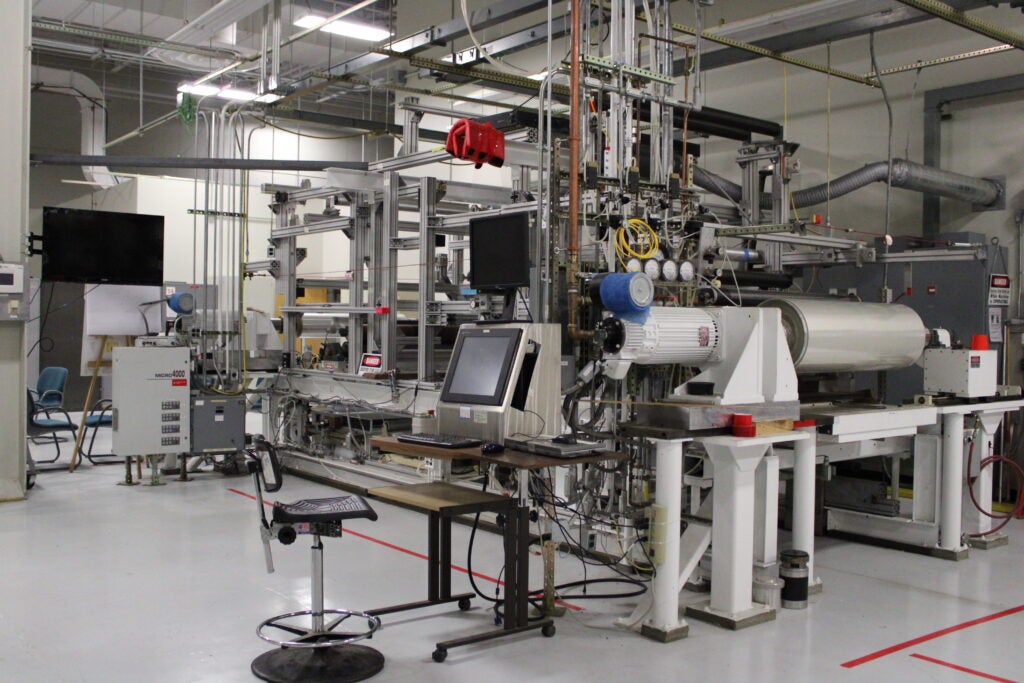
One of the most effective ways to evaluate roll-to-roll improvements is through access to in-house testing facilities that closely replicate real production environments. These environments bridge the gap between controlled laboratory experiments and full-scale manufacturing, allowing manufacturers to observe how materials, equipment, and process variables interact under realistic conditions.
This level of testing provides deeper insight into system behavior, uncovering performance limitations and opportunities that are often not visible in theoretical models or small-scale trials. By working in a setting that mirrors actual operating conditions, teams can generate meaningful, actionable data that supports more confident decision-making.
Using systems such as Re:Build Optimation’s Media Conveyance Facility, manufacturers can:
This approach bridges the gap between laboratory testing and full-scale implementation, providing a practical path to improvement.
Capital investments in roll-to-roll equipment are often substantial, not only in upfront cost but also in their impact on operations, timelines, and overall production strategy. These decisions typically involve multiple stakeholders, tight schedules, and high expectations for performance. When an investment does not deliver as expected, the consequences can extend far beyond the equipment itself, leading to unplanned downtime, integration challenges, reduced throughput, and ongoing operational inefficiencies.
Testing before investing provides a structured way to reduce this risk. By validating performance in advance and understanding how new technologies or process changes will interact with existing systems, manufacturers can make more informed, confident decisions. This proactive approach helps ensure that capital investments are aligned with real-world performance requirements and long-term operational goals.
Testing before investing reduces this risk by:
This proactive approach helps manufacturers avoid costly surprises and ensures that investments deliver the expected results.
Not every decision requires full-scale testing, but certain scenarios benefit significantly from a structured, real-world evaluation before implementation. When process performance is uncertain, materials are changing, or new technologies are being considered, testing provides a practical way to reduce risk and validate assumptions.
Rather than relying on trial and error in a live production environment, manufacturers can use testing to gain clarity, identify potential challenges early, and ensure that any changes will deliver the intended results. This approach is especially valuable when the cost of failure is high or when process stability is critical to product quality.
Consider testing when:
In these scenarios, testing provides clarity and reduces the likelihood of costly trial-and-error implementation.
When implemented effectively, pre-investment testing for roll-to-roll systems delivers both immediate and long-term value by reducing uncertainty and improving the quality of decision-making. Rather than relying on assumptions or limited vendor data, manufacturers gain a clear, data-driven understanding of how specific technologies, process changes, or equipment upgrades will perform within their actual operating environment.
This approach not only minimizes the risk of costly missteps, but also ensures that investments are aligned with real performance improvements. Over time, these benefits compound, leading to more stable operations, higher yield, and a stronger foundation for continuous process optimization.
Over time, these advantages contribute to more stable operations and stronger overall process capability.
Improving roll-to-roll manufacturing performance is not just about selecting the right technology. It is about understanding how that technology performs in your specific process. Testing before investing allows manufacturers to replace assumptions with data, reducing risk and enabling smarter decisions.
At Re:Build Optimation, we help manufacturers evaluate new technologies, test process improvements, and identify opportunities to improve yield through real-world validation. If you are considering changes to your R2R system, the best next step may not be a purchase. It may be a test.
If you are evaluating new equipment or looking to reduce defects, our team can help you test solutions using your actual material and process conditions. Schedule a material evaluation today.
Looking to connect with an experienced team?
Look no further than Re:Build Optimation! We are excited to connect with you.
